1-to-many wireless screen casting and awind odd machine multicast screen sharing scheme
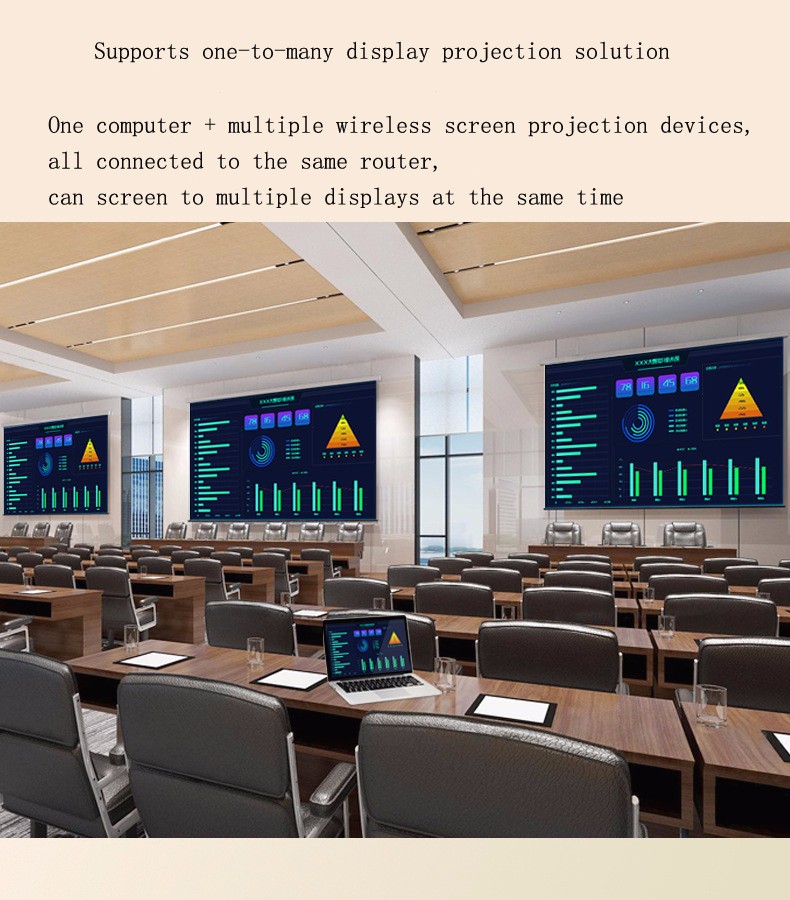
Currently, wireless users are increasing, but wireless / wired bandwidth resources are quite limited. In order to effectively solve the problem of single-point transmission and multi-point reception, the multicast technology is applied to the network on a large scale, saving bandwidth and effectively avoiding channels. The possibility of congestion. To put it simply, multicasting is to display a signal source on multiple display screens simultaneously, which is what we often call a 1-to-multicast screen. As shown in the figure:
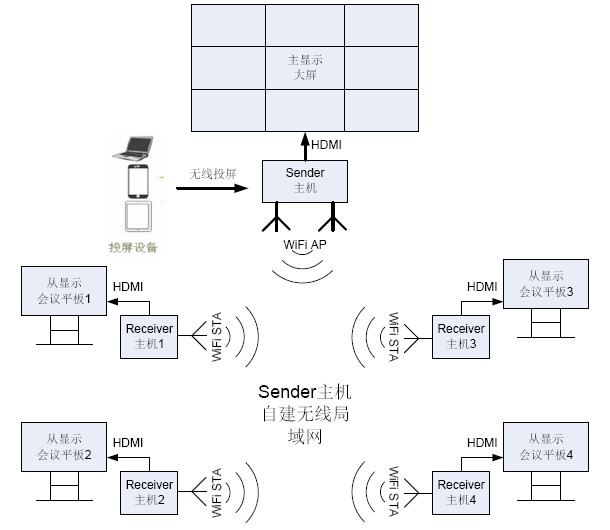
Multicast screen sharing scheme
Background requirements:
Multicast is also called multi-target broadcast and multicast. A transmission method used in the network that allows the transmitted message to be transmitted to a selected subset of all possible destinations, that is, to convey information to a variety of explicitly specified addresses. Is a method of communication between a sender and multiple receivers. For example: use a computer as a host and control multiple display screens at the same time.
Application scenario
Multicast applications can be roughly divided into three categories (1 to many, many to one, and many to many), but in the multicast screen sharing solution, the most widely used method is one-to-many screen casting. such as:
Media broadcasting
Events such as conference lectures, presentations, video teaching, etc. Its traditional media distribution methods usually use television and radio. This type of application usually requires one or more constant-rate data streams. When multiple data streams (such as voice and video) are used, they often need to be synchronized with each other and have different priorities. They often require higher bandwidth and less delay jitter, but the requirements for absolute delay are not very high.
Event notification
Such as network time, multicast session schedule, random numbers, keys, configuration updates, valid range network alerts or other useful information. They have different requirements for bandwidth, but they are generally relatively low, and their latency requirements are also average.
Status monitoring
Such as stock prices, sensing equipment, security systems, production information, or other real-time information. This kind of bandwidth requirement is different according to the sampling period and accuracy. There may be a constant-rate bandwidth or a burst bandwidth requirement. Generally, the bandwidth and delay requirements are average.
Advantages of multicast screen sharing: increase the use of wireless networks.
Disadvantages: Excessive multicast traffic will consume wireless network resources, and the stability of multicast traffic cannot be guaranteed.
AWIND's wireless projection screen device has become more powerful and complete after multicast. It is favored by corporate conference rooms and school education.